
What are the best online learning platforms?
Someone always asks me what platform they should use for their online courses. And my answer is always the same.
They're all garbage.
So I'm gonna paint you a picture.
We've got someone who spends three months building the perfect Kajabi set up.
They've got custom branding, a beautiful sales page, and automated email sequences. Everything the tutorials told them to do.
They launch, they sell it. People sign up. Six months later, they have a 4% completion rate. They're getting refund requests. They've got students who bought it and then disappeared, which means they weren't successful.
The platform worked perfectly. The course did not. And it was never clear that it could shake out that way because most course platforms weren’t designed to actually care about whether or not people learn things.
And that's why there's always something missing from comparisons when we’re on the hunt for the best online learning platforms for our businesses.
They’re solving the wrong problem.
The problem course platforms actually solve for
They’re solving the wrong problem because they’re building answers to the wrong question: How do we help creators sell and deliver content?
And that’s how these platforms ended up as content repositories.
Because they’re not trying to solve the: how do we help our clients actually get success? Problem. ←That's a learning problem.
Selling and delivering content is what people who create courses think they're supposed to do, so course platforms have tried to make it easier for you to do that.
What it hasn't done is created spaces where clients can come in and actually learn and be successful, and that is causing problems. In the field of education, we’ve known for a long time that learning doesn’t happen through osmosis. We don’t just transfer or upload info to someone and they can automatically remember it and use it.
That means when your course fails. When students drop off, when they're not completing things, when they're asking for refunds, when they're not recommending you, when testimonials don't come. The platform isn't going to tell you why. It's just going to keep charging you $200 a month.
So what are you supposed to do?
Start with figuring out what you need to build
Before you dig into finding the best online learning platforms, you’ve gotta know the foundational pieces of your course. If you don’t know what they’re going to do or how you’re going to deliver, it’s like playing pin the tail on the donkey and you end up being the a$$ that pays for a platform that doesn’t work.
If you don’t have those sorted yet, start with my post on how to create an evergreen course, and then come back. Once you have them, you can dig into these learning design questions (if you’d rather have these answered for you, this is the first post in a series of platform reviews, so check the list at the bottom for which platforms and whether or not they’re live).
Questions to Evaluate Course Platforms
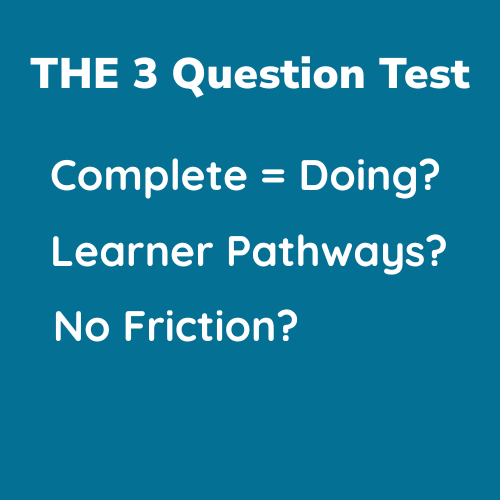
If you give a sh*t about whether or not your course clients get results, at least questions 1 (being able to track things that matter in completion) and 3 (friction) are mission critical. It doesn’t matter if you plan on creating an evergreen course; data and doing are critical no matter what. IF your course goals bring in folks that seem to be starting at different points, question 2 (making pathways easy) is also for you.
Completion that Tracks Doing
Can you build some sort of completion marker tied to the activities or the implementation of the information (not just to the video watch or click complete)?
So a lot of courses will have “watch this video fill out this PDF, watch this video fill out this PDF.” And so when students get to the end and they've watched all the videos, it might look like they finished your course, but they got nothing out of it because they didn't actually apply any of the information.
There is a big difference between a client watching all those videos and actually doing the work, the implementation, the thing that is going to get that change for them. And so if your platform is only tracking when someone presses play and the video runs, it's time. It can't tell you if they're applying anything.
Branching paths
Can you build branching paths so that clients only see what's relevant to them?
Not every client starts from the same place. Not every client comes in with the same experiences. They should be at the same level (which is a whole other conversation <insert blog link when I convert that video>), but there are still differences. A platform that shows everyone the same linear list of lessons is treating your clients like they are all identical, but they're not.
Clicks between learning and doing
How many clicks does it take to get to the center of a tootsie roll pop? No, I'm just kidding. How many clicks does it take to get from: “I finished the video” to “I'm doing the activity”?
Count them out loud in the platform you’re considering. Every extra click is friction, and friction kills completion. Most course platforms bury any actual kind of learning work under navigation menus and next lesson buttons that prioritize content delivery over actually doing something with the content.
Testing Course Platforms
When you’re trying to determine what platform to use, if you are in fact ready to choose a platform, you’ll want to start with what your course needs to narrow down the ones you test, but then use the questions to dig into whether it’s a good fit for learning.
I have tested several online learning platforms against those questions for you (and you can skip to that here) . BUT they can be used on any course platform you’re considering. So if you have the foundational pieces of a good course, go ahead and test it based on what your course needs and those three questions.
For context for the reviews, I use the same lesson from my own course every time. Specifically, it is a brain dump exercise that has three different paths depending on where my learners are starting from.
So when people enter my course, they typically
are an expert in something and they want to teach someone else.
have been working with clients one on one, and they want to build in some sort of asynchronous learning component to that one on one work, whether that's from moving from service based to letting helping clients do things on their own.
have done a course live and they're trying to make it more evergreen or fixing a course they’ve already done.
It has a timed activity. It has some branching logic based on those three paths. And it has clear next steps. It is not super complicated. I built it originally in a frickin Google doc, but it's enough to show you exactly where each platform shines and breaks. And I'm going to tell you right now, none of them has all three (even the one where my course currently lives).
Course Platform Comparison: How 15 Online Learning Platforms Scored
So by the time I got to the end of this YouTube playlist , I didn’t actually have a recommendation. But hopefully you'll find something that is going to better fit what you're doing along the way.
Some fail one. Some fail two. Some fail all of them. Some are so bad they don’t get the full review.
The question is never which platform is best because like I said, they're all garbage. The question is why none of them are actually built for learning.
The conditional passes are places where a creative workaround could sort of get me there, but they’re all clunky. Each piece includes “this is and isn’t for you if…” as well.
BEFORE you dig into the headache that is choosing the least shitty platform, it might help to make sure you’re ready to pick.
Best Course Platforms Review Comparison Table
- Pass
- Conditional pass
- Fail
A conditional pass means a creative workaround could sort of get me there, but every one of them is clunky.