
What Makes a Good Course (AND What Makes a Bad one?)
I’m sure you have bought a course where clearly they didn’t care about whether or not you were actually successful. They took your money with their fancy marketing and then they ghosted you. Clearly, that is not a good course. Unfortunately, you’re not alone, and it’s become what’s expected, and it shouldn’t be that way because we know better.
And when we know better, we can do better. So if you’re considering creating a course and you want to do better, this post is for you.
Let’s talk about what makes a good or bad course by first talking about the bad.
What is a bad course?
When I decided to leave higher education, I thought I was just going to get a job, so I bought a course. That course was supposed to help me get from PhD to industry. And it was an absolute garbage heap.
It was such a miserable experience because there was no start here, no goal setting, no clear outcomes, no pathway through the bajillion modules that were titled by job. I didn’t even know the job I wanted yet. I thought that’s what it was helping me with.
When I did finally choose a random place to start I found mostly live recordings, which I get makes it easy, but live things ramble and meander. Some folks insist you can get “value” out of them, but shouldn’t have to when it’s a course where the recording isn’t because you missed the live. It’s because they were trying to save time (or just didn’t give a sh*t).
Some folks have shared that they bought a course and it was basically an ebook, others have bought courses that are a collection of other people’s content.
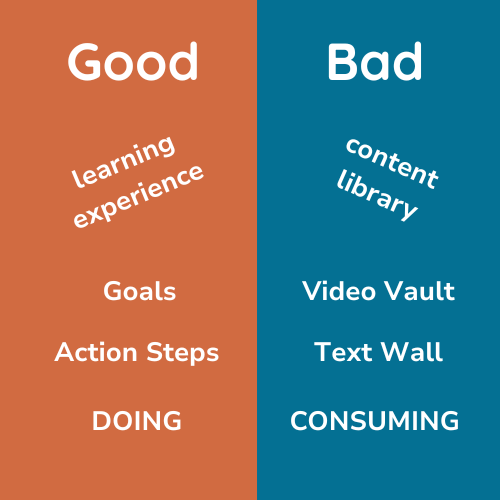
The pattern here? Bad courses look like books or paywalled YouTube. If your course isn’t action-oriented, they’re not going to learn from it. You can’t just dump information into somebody’s head. They have to engage with it in some way. If there’s not some sort of action (like, if you watch this video, then answer these questions and then share them with me) it’s action and accountability.
A course is a learning experience, not a curated content library. Let’s start using the right words.
What is a good course?
This is going to sound like a sh*tty answer, but it depends. A good course looks different depending on who you’re teaching and what you’re teaching and whether or not it’s going to be effective.
So many people get stuck in this mentality of it has to either be live or it should be self-paced on demand. And there are so many hybrid flavours of what you can do in between that make it friendly to anybody. That’s why “it depends” is the answer.
BUT at the core, a good course creates change through learning.
AND there are a few foundational pieces for making sure your course is an experience people can actually learn from. A good course is:
Action oriented
Accessible
Build on learning science foundations
Uses learner research to create the structure
Marketed ethically
A good course is validated through learner research.
A big mistake a lot of folks make is thinking about their future learners ONLY as buyers. They jump into market research and only ask typical buyer behavior questions.
The folks that I know who have the best luck selling their courses are people who have done learner research frequently throughout the process and asked the right questions.
Not about their car or how many cats they have, but things that actually impact what kind of result they’re looking for, why, and who they are as a learner. People come with baggage, all kinds of baggage from learning experiences.
Learner research can be used to both build something they can be successful in AND something they’ll buy.
The learner research goes hand in hand with the course goals.
A good course focuses on goals and actions
Start with the goals of the course. We’re not talking vague “Understand…” or “Learn…” BS goals. We’re talking action based goals. Those start with action verbs.
“Create…” “Analyze…” “Describe…” These are things that you DO.
After you have the goals established, you work backwards from those goals. You ask yourself “What’s the step right before they reach that goal?” Then keep going till you hit that first step, so what’s the step before that? And the one before that?
Once you’ve got your steps outlined, you’ll fill in the tasks for each step. Think of this like a to-do list for each step. The first thing they have to do is this, the next thing they do is that, etc.
Your to-dos then need how-tos. Go through and list how they’re gonna be able to check off each of those to-do steps. Then, and ONLY then, put in the content they need to do the thing.
This is how you prevent a bloated course that looks like a reference library, and it’s how you prevent cognitive overload. Cognitive overload is this idea that you can only hold so much new information at one time.
If we’re thinking about really learning and applying something new, it has to happen in smaller, action-based steps in order for us to get the information, understand the information, and then have time and space to recall the information to then apply it.
A good course removes barriers before they’re problems.
When we unintentionally set up barriers to learning by making our courses inaccessible, we either end up losing folks or we have to be reactive when we get complaints (or worse, get sued). Creating an accessible course that’s completable by as many people as possible takes being proactive (instead of reactive).
There’s this theory called Universal Design for Learning (UDL), and it is: if we design things to be accessible for the people who need it, then it will be accessible to everyone. For example, if you have a video, the audio pulled out, and also a transcript, it’s accessible to those with hearing loss, vision loss, and if I need to listen because today I’m driving my kids all over the place, I can listen instead of just reading it.
The nuts and bolts of accessibility are super helpful as a starting point. If your course is not accessible, having captions, the audio file separate from the video, and a transcript; those are beautiful ways to get started.
Accessibility is one of those things in courses where you can always find a way to make it better. But taking those small steps and every time changing something just a little bit more to make it a little bit better based on real human feedback, that can go a really long way. Iteration is your friend in courses and in accessibility.
A good course asks the platform question last.
I’ve said it before and I’ll say it again: all course platforms are crap. Course creation platforms try to do a lot of different things at once, and when you try to do too many things, you usually end up being bad at at least one of them. They’re still embedded in this idea that content equals a course, and so they’re just designed as content repositories that, in the worst cases, really hinder how you structure a lesson.
For you, that means making sure you know what’s going to be in your course before making a decision. That list of “this is what I need them to DO to get the change they’re looking for” is your guide for picking the least sh*tty course for you and your learners.
A good course holds up when a smart buyer is deciding.
Would you buy your own course?
You’ve been in the buyer seat that leads to regret, and you don’t want to do that to your own clients.
You have to cut through the fancy marketing and look for words and phrases that will tell you that there’s support in there, even if it’s just tech support. If it’s sold as an on-demand or self-paced course, they should still be answering questions. Look for a place to get hold of a human being. Things like being able to clearly articulate what’s in it, what you’ll do, and what the goals are. And if they’re not on the sales page, ask, and if they won’t answer, don’t buy it.
Consider the credibility. What does a 100K launch actually tell you? It just tells you that they’re good at selling things. It doesn’t tell you whether or not anybody who bought that course was actually successful in turning around and doing anything with it or getting what they needed out of it.
You know what buying a bad course bought you; don’t hand that to the people who trust you with their money. If you’re not sure where to get started, check out my Course Maker Jumpstart Challenge.
*This blog was originally a podcast conversation with Randi from Chronically Cozy, if you wanna go listen to the conversation “How to Build Online Courses that Don’t Suck” (aaaand it’s probably clear why we get along).