
Creating A Self-Paced Course That Gets Clients Real Results
So many self-paced courses are created by business owners who have their heart in the right place but need help understanding teaching (what it is, how to do it, etc.).
That has left us with a slew of (cr@ppy) courses that do the “learn all the concepts and then do the thing” move. That typically looks like
“Here! Have all this information!”
Three modules later…
“Here! Do the Thing!”
Which means they focus on information delivery as “teaching.” One big project, or watch all six videos and then do the worksheets, or complete the course and then implement in your business.
These kinds of things can feel logical because they do need information in order to be able to do something with it, but, and it’s a big But, this model fails.
Table of Contents
Why Info Dump Plus Workbook Doesn't Work (and Your Students Aren’t Completing Your Course)
Some of the things we know about learning science and adult learning theory is that our memories are faulty and only hold so much. This becomes a bigger issue in self-paced courses because there are a bunch of things that cause us to not remember sh!t. This makes active learning critical to a self-paced course, and understanding teaching adults online is how we do it.
Buckle up.
Your memory has a capacity
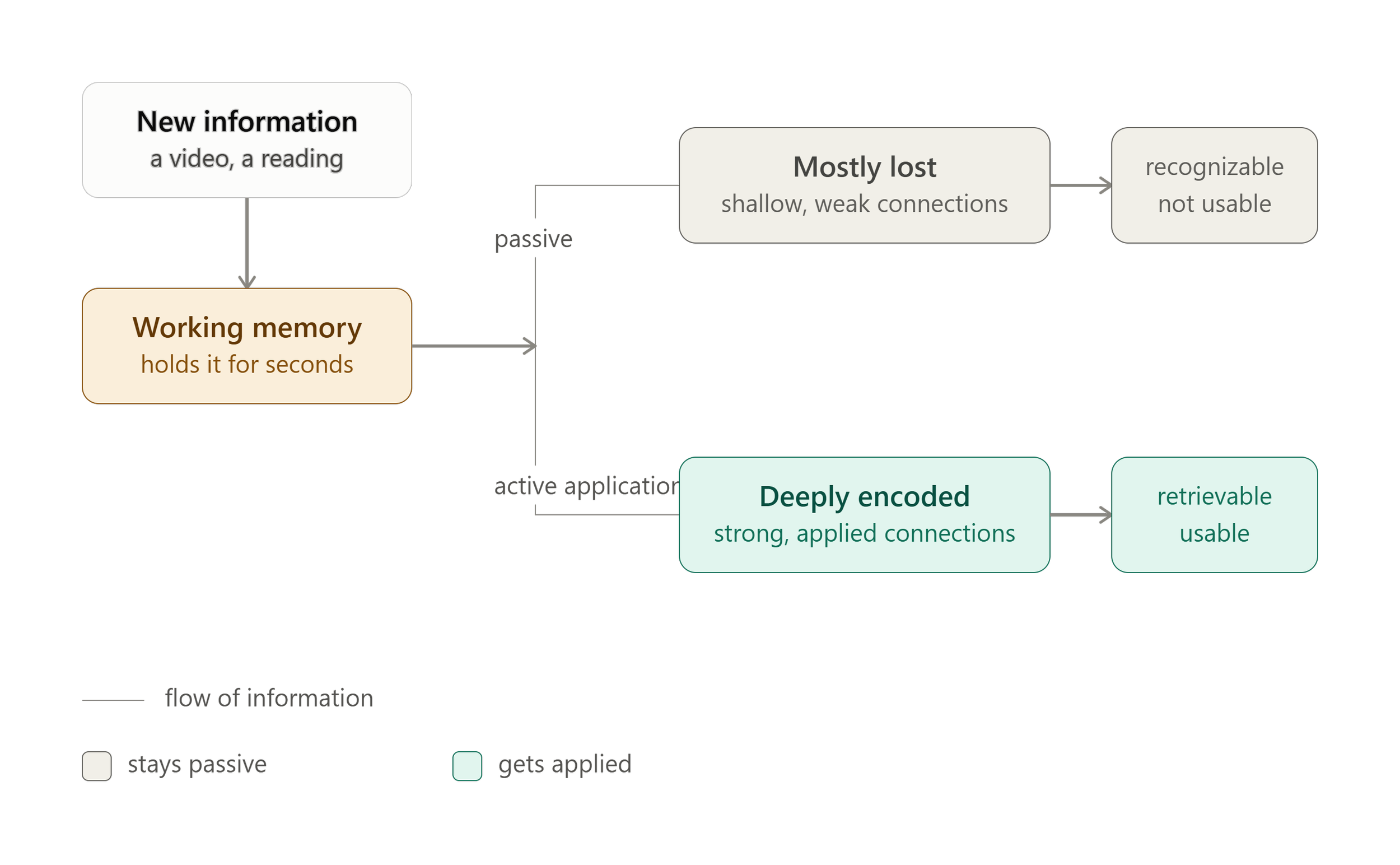
Working memory can hold three to five things for mere seconds. So if we haven't pulled the info we need from working memory into long term memory <insert memory post>, we have a problem. But that shift into long term memory takes time and repetition and active engagement.
This means if you taught six different concepts across three modules, and they're supposed to remember all six of those concepts when they go to apply it, they are not going to remember them all.
And that's why “later” is happening too late, because they can't remember what they're supposed to apply.
Course engagement NEEDS active application
Actively applying what we’re trying to remember forces us to engage and process while we’re trying to encode, burning it into our brains, in our long term memory.
Watching and reading CAN be active, but they’re often not (and just because you actively read and watch doesn’t mean that others can or know how to; we don’t design courses for ourselves).
But unless you are really applying it, whether that's engaging with it by thinking about how it applies to your own situation, or actually doing something with it in the moment, then it's considered passive.
And passive content consumption leaves the information at the mercy of working memory.
So when we get to the end of the 4 videos and need to apply the thing in the PDF workbook, there is very, very little, if anything, stored to retrieve.
Sometimes, when we're watching a video, or when we're reading something, we are actively thinking about it. But how many times have you read a page or two and said, “I have no idea what I just read”?
It's because you weren't engaging with the material enough to be able to pull it into that long term memory.
But even when information does make it into long-term memory because we’ve engaged with it, there's another problem. Remembering something and being able to do something with it aren't the same thing.
Knowing it and doing it are different skills
Separated learning creates declarative knowledge ("things I know about X") instead of procedural knowledge ("things I can do with X"). When you separate providing information from doing something with it, you create isolated knowledge, not a usable skill, which is the thing that leads to change.
And we're not just talking about concrete skills like attaching a file to an email. They might be skills like calming yourself down. They can be squishier things and still be skills.
Because learning and memory and knowledge are about retrieval, pulling information from your memory. The thing that triggers retrieval, the retrieval cue, depends on how the information was stored in the first place. A trivia question is one kind of cue. “Apply this to your business” is a different kind of cue entirely.
To use what you know about email marketing, you need to be able to retrieve it in a way that makes it useful to you at that time. So when you acquire knowledge separately from applying it, the brain doesn’t file the two things together. Things I know about email marketing. Great for business trivia. Doesn’t help you write the welcome email because “do the thing” is a different cue and the connection isn’t strong enough between them.
You're also not able to explain email marketing deeply to other people. You should be able to take what you know about email marketing and apply it across different industries, different contexts. That takes critical thinking, and application helps us do that.
Delayed action leads to confusion and delay
If you're delaying taking action on the knowledge, you don’t know if your learner is understanding. If they misunderstand the concept, there is no application to reveal the misunderstanding. And misunderstanding compounds.
If they missed something in Module 2 and are applying in Module 4, they either get lost and quit or have to go back. This leads to overwhelm.
Why the learning strategies you know and love don't work (especially when you design a course)
People assume that common learning strategies will solve all these issues, but most business owners use learning strategies on the surface level. That means it’s BS.
So what that might look like:
You hear passive learning doesn't work; you add learning strategies like highlight key points that you read, take notes in your workbook, reflect on how this applies to you, review this material before moving on.
This still leans into the content first, give them the workbook. And it's a problem because the strategies are still separated from the learning and they are putting a lot of the onus on knowing how to engage with content on the learner.
That's a learned skill. Some people do it naturally, but for most people that is a learned skill.
Engaging with it, especially if it's brand new or in some cases, if it is a situation where they're not entirely invested in it because they don't understand how it connects to the thing they are invested in doing.
Before you take the time to fix your course, check to see if your course sales problem is a sh!tty course or a marketing problem with a quiz.
Random highlighting is not processing.
How many times have you highlighted something you read, digital or on paper, and ended up highlighting most of the page because you were trying to remember everything and thought highlighting was what would help you remember?
The problem is that "highlight what's important" assumes you know what's important. When someone is learning something new, they don't know that yet.
So it's normal to highlight everything or nothing. Either way, if you're highlighting without a specific purpose, it's busywork. There's no cognitive processing pulling out the information they'll actually need. The information still isn't transferring into long term memory.
Generic reflection prompts after the fact.
Things like: watch all the videos in modules one through three, then reflect on how you'll apply "this." That kind of generic prompt is a problem because they can't remember what "this" is.
There's too much "this" to think about how to apply it, and there often hasn't been any direct instruction on ways it might be applied. By the time they get there, working memory has already dumped some of the information.
They can't reflect on all of it, and it's harder to pull multiple concepts into a situation if you haven't worked through them on a smaller scale first.
Separated workbooks don't work.
Part of the problem is the course platforms we're on. Nothing is built to do the work that learning online actually takes. So everyone that’s trying does the: download the workbook, complete it after the module.
By the time "later" rolls around, clients have forgotten what you were talking about in the videos. It isn't directly connected to the thing they're doing. You're not saying "go do this" and showing them what that looks like in the moment.
So if the workbook asks them to apply concepts from videos they watched days ago, they've got nothing to pull from. They're probably going to have to go rewatch the video.
The separation between content consumption and action is still there.
Ok, so now ya know what doesn't work and why. Here's what's actually happening in your client's brain when we design for things that DO work.
Just remember:
A workbook with reflection questions can look like you've fixed the passive problem. You're not just handing over six videos, you're asking them to do something.
Except if the doing happens after the content instead of inside it, you've still got the separation problem. Engagement as an after the fact to the content doesn't work because engagement isn't a feature you add.
Engagement is the teaching strategy.
It's not separate from how you teach the concept, it is how you teach the concept. And that’s why understanding teaching is a critical piece of a successful self-paced course.
So what actually gets students to finish your self-paced course?
When your students passively consume things, they do encode something. They can remember some of what they watched, but not enough to use it. When your learners watch, read, or listen passively, most of that information doesn't make it to long term memory.
And if it does, the encoding is usually shallow. Surface level. The connections aren't strong. It's often enough to recognize, "oh yeah, I remember hearing about that," but not enough to actually retrieve it and apply it.
Active processing helps us encode things deeply enough to use them. When you're engaging actively with information, the encoding goes deeper.
You're connecting it to other knowledge, tying it to other concepts, practicing it. That's what makes it strong enough to retrieve across different contexts. Usable, not just recognizable.
When self-paced courses separate consuming from engaging, we end up with shallow encoding. A student watches a video about subject lines passively. The shallow encoding might be: subject lines should be specific and create curiosity.
Later, sitting down to write one, they think, "I know there was something about subject lines," but they can't retrieve the specifics strongly enough to apply them. The connection is too weak.
Generic reflection questions don't fix this either. "What did you learn from this video?" Students say, "subject lines need to be specific and create curiosity." That's just repeating what they heard. Regurgitation isn't processing. It doesn't strengthen the connection.
The secret to a self-paced course clients get results from
Targeted engagement.
Things like: write a subject line for this specific audience on this specific problem, while they're watching the video. Suggest they pause. Give them sentence starters. Now they're processing.
They're connecting "specific and curious" to who their audience actually is and what they're writing about.
That's deeper processing, the kind of thing people mean when they talk about critical thinking: taking information and immediately applying it to your own context so you can use it on your own. It's stronger because the connections get built more than once.
Shallow encoding is "I remember learning about this." Deep encoding is "I can take what I remember and do it." Information and action need to be integrated so the connections get built that let people actually do the change they came to do.
Let’s see what this looks like in practice.
We want clients to learn the concept, apply it immediately, get feedback, and refine their understanding.
It's a cycle: working memory holds the concept long enough to use it, application brings in active processing, that transfers it to long term memory. Feedback redirects misunderstandings before they compound. Learning strategies aren't add-ons, they're how the curriculum is built.
Example time.
The integrated model
We’re gonna pretend I’m creating a course on creating a course (ok, so I do have one in my membership).
This is what it might look like when we’re using the doing to teach the knowledge.
| Lesson | What they're taught | What they do | Feedback |
|---|---|---|---|
| 1 | What a learning objective is | Write a rough draft | Does it describe an action? |
| 2 | Refining objectives | Revise their draft | Is it specific and measurable? |
| 3 | Common mistakes | Apply the fix to their own draft | Self-check against the mistakes list |
So lesson one isn't "here's the definition of a learning objective, now go write five." It's "here's the definition, let’s write one."
Say a learner writes: "Students will understand how to write learning objectives." That's the most common mistake there is, "understand" isn't an action you can observe or measure.
The immediate feedback (yours or a self-check if it’s a self-paced course that’s also DIY) is one question: does it describe an action? They look at "understand," realize it's not one, and revise to: "Students will write a measurable learning objective for their own lesson."
That revision is the learning.
They didn't get the rule and then apply it three modules later when they've forgotten what "understand" was even doing wrong. They got the rule, ran headlong into their own mistake, and fixed it while the concept was still active in their working memory.
That's learning by doing it, not learning about doing it.
By lesson three, they're not just remembering the rule "use action verbs." They're checking their own drafts against it, because they've already felt what it's like to get it wrong and fix it.
That's the difference between information transferred and information transformed into something they can use on their own.
When they're built in, they can't move forward without doing the thing. They can't skip the workbook entirely. The doing happens while the information is still in their working memory.
But if it's kind of just an add on, then the doing happens after they have already started to lose some of the information.
What you can do right now to create a self-paced course students can finish
Pick one lesson in your course right now. What's the one thing you're asking them to know? Now write the one thing you want them to do with it, immediately, before they move on. That's the whole exercise. Small, doable, no workbook required.
Stop asking what they need to know. Start asking what they need to do. Start there, and you're automatically building a curriculum where they're actively using information.
Because once you know what they need to do, you can figure out what knowledge they need to do it, not what knowledge you think you need to impart on them.
If you want help building a self-paced course that works instead of figuring it out alone (or worse, putting another sh!tty course into the world), that's what Course Partner is for. If you’re more of a DIYer, check out the membership.
So the rest of this blog series is about how to design that integrated learning in your course.
We're gonna talk cognitive load.
We're gonna talk chunking.
We're gonna sprinkle in a little instructional design theory in ways that you'll be able to do something with it.
We're gonna talk about ways to help strengthen those connections. So people can use the things that you're trying to teach them.