
How to Design a Course That Gets Results (It Starts With How Learning Feels)
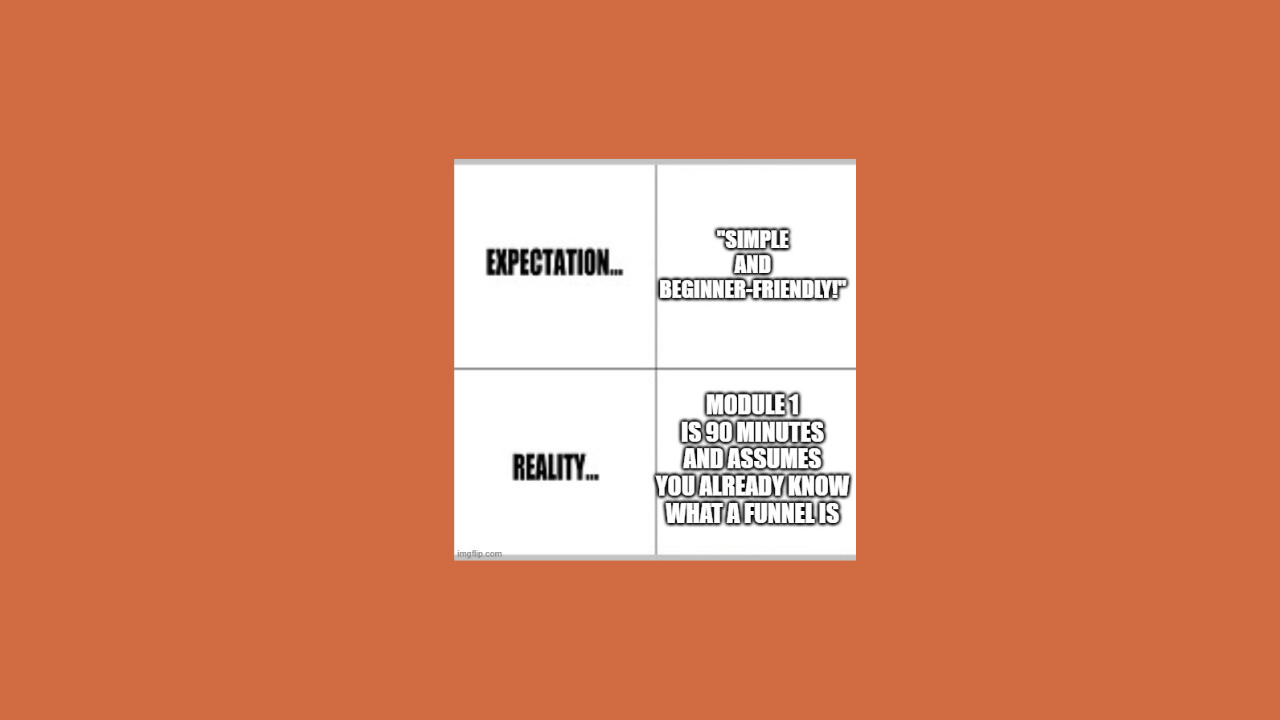
Expectation: Simple and beginner-friendly. Reality: Module 1 is 90 minutes and assumes you already know what a funnel is.
What makes a learning experience good?
Success. When I feel successful—like I've gotten what I needed, I've had that lightbulb moment, I've got a handle on the new skill or mastered the old one. And I did it all without a ton of challenges. Well, maybe without a ton of unsupported challenges. Leave me too challenged and I'll get frustrated and stop; don't give me any challenges and I'll get bored and stop.
See how emotions impact motivation to continue? It's not just me. There's a ton of research that points to similar results (with varying degrees of frustration and boredom being tolerated). While the book The Spark of Learning is directed at higher ed, guess who's in higher ed? Adults. The NCES estimates that 74% of adults in higher ed are non-traditional, meaning they're adult adults (as opposed to fresh out of high school still figuring out what adulting is).
There's a special word for the teaching of adults. It's called andragogy. So anything that applies to adult learning applies to anyone in higher ed, course creation, corporate, tech, etc.
Your Good Learning Experience ≠ My Good Learning Experience
So my good learning experience is also your good learning experience? Ha. Of course it's not that easy.
My good learning experience is about a balance of emotions driven by experiences both past and present. The difference between me and you is a tolerance of certain emotions, what the motivator is, and what those experiences are.
And you can have a single moment in a situation where you're supposed to be learning something that just throws everything off.
When I was in high school, I was in AP English (not surprising for those that know me for real). I thought I struggled with writing, based on feedback. I was, and am, a heck of a reader, though. Ask me about my trophy some time.
But then I got an assignment where the writing just flowed—it was a speech, and so full permission to write the way I talk. (I know, right? When does that happen?)
And then I was accused of plagiarizing.
I was devastated, embarrassed, angry—all the emotions you can imagine feeling when you turn in something you think you just hit out of the park to be told they don't think you're actually good enough to have done it.
That moment has followed me and impacted most of my higher education experience. My application letters started with "I've always been a reader, not a writer" to explain my drive for getting two advanced degrees in writing.
Don't worry, I'm over that BS. But do you see how one small thing that resulted in intense negative emotions impacted all of those other learning experiences? I threw myself into it because I thought I was bad. Some people withdraw from things because they think they're bad at it.
Everyone Brings Baggage
A good learning experience is not only counteracting learning baggage, but trying to reorganize the suitcase and throw out the non-essentials for continuing to learn in the new space.
And everyone's luggage is different—different sizes, shapes, colors, contents and motivations for making the luggage all those different sizes, shapes, colors, and filled with all those varied experiences.
So how the hell do you counter all that sh*t to make someone feel successful in your course?
If you want to design a course that gets results, you need to address the emotional reality of learning—not just the content. Here's how.
Alignment
You make sure your course aligns with your marketing or description or problem you're solving.
Experiences and expectations matter in learning. Studies have shown that when learners' experiences don't match their expectations, they're less likely to be successful—and so are you. If the course they're taking doesn't match their expectations in terms of content, workload, time spent, or what they're going to learn, they're going to be less motivated to continue. Which means more refund requests, fewer positive reviews, and less engagement. All of those things lead to less growth.
What this looks like: Say you're selling a course on "Instagram for beginners." If your marketing emphasizes "easy, 15 minutes a day" but your course includes two-hour modules on algorithm strategy, you've got a mismatch. Your learner expected simple and got overwhelmed. They'll either ask for a refund or quietly disappear—and they definitely won't buy from you again. Alignment means your promise and your delivery match at every level: complexity, time commitment, and outcomes.
Checking In
You create space for checking in and getting an idea of background and experiences.
This is related to alignment, but it's about understanding where your learners actually are—not where you assume they are. If you know where they're coming from, you can course correct to fit the needs of your current learners. Focusing on who you have in front of you can go a long way in eventually helping you build something that is more accessible to more learners.
Always check in at the beginning to learn about what luggage they're coming with. Check in in the middle to see how the unpacking is going. Check in at the end to see how it went. Ask specific questions about their experiences and expectations. I like to call these "ticket out" surveys.
These check-ins lead to a better experience because learners feel heard and understood on their learning journey, no matter what their experiences are.
What this looks like: A pre-course survey that asks "What's your biggest fear about learning this?" or "What have you tried before that didn't work?" gives you insight into the baggage they're bringing. A mid-course check-in that asks "What's confusing you right now?" lets you address problems before learners give up. These don't have to be long—even a single question can surface what you need to know.
Space
You create space for questions, concerns, and general "AH! Help me!" moments.
Make it easy to get help. The check-ins will help with that, and sometimes you can anticipate what help they'll need. For example, you can't always control what your course user interface is like, so FAQs that help with navigation go a long way. You need to anticipate a variety of tech experience.
Create space for anticipated support. Create space for just-in-time support. Create space for your learners to chime in for things you didn't anticipate.
Creating these spaces leads to your learners feeling confident in completing the course because they can get the help they need no matter how they come to you.
What this looks like: A pinned "Start Here If You're Stuck" thread in your community. A short video walkthrough of where to find things. A weekly office hour or even just a "reply to this email if you need help" that actually gets answered. The format matters less than the accessibility—learners need to believe help exists and that asking for it won't make them feel stupid.
Transparency
You create a course that brings them along for the ride.
Every step of the journey is clearly connected to the next and the previous steps so they can see and understand how they're working toward the end goal. Clarity is key here—while you know how things are connected and it might feel obvious to you, don't assume it's obvious to others. It will especially be true for folks who are new to whatever it is you're teaching.
This is critical for helping your learner feel like they're actively participating in their own learning—it helps them connect to the value that the course offers them.
What this looks like: At the start of each module, a quick sentence like "Last week you learned X. This week we're building on that by doing Y, which sets you up for Z." At the end of each module, a reminder of what they just accomplished and what's coming next. You're not just teaching content—you're narrating the journey so they can see their own progress.
Design a Course That Gets Results by Starting With Feelings
When I set out to write this post, I wasn't sure where it was going to land. But landing on how a learning experience makes you feel is a good starting point for designing a course that actually works.
If you start from there—from the emotional reality of learning—your learners will have a greater chance of being successful no matter what color, size, shape, or condition their education baggage is in.
Want Help Figuring Out What to Teach?
If you're still in the "what should my course even be about" phase, grab my free Course Creation Jumpstart. It walks you through ideation step by step so you can land on a focused topic before you start designing.